Walk into almost any school library built before 2010 and you will see the same thing. Row after row of shelving, most of it only partially filled. Quiet carrels designed for solitary research. A circulation desk built around a collection students now access on a device they carry in their pocket.
The library was built for a world where information lived in stacks. That world has changed. Every student in a 1:1 device program carries access to more information than those shelves ever held. What they do not have is a space designed for how learning actually happens today.
Schools across the country are rethinking this. And the ones doing it well are not just swapping old furniture for new furniture. They are rethinking the purpose of the space entirely. Turning it from a place you go to find information into a place you go to do something with it.
This guide is for the K-12 decision-makers working through that question right now. Here is how to approach the renovation in a way that holds up.
Start With an Honest Assessment of What You Have
Before you redesign anything, take a clear look at the space as it exists today. Not as you wish it were, not as it was described in the last facilities report. As it actually functions on a typical Tuesday.
Walk through during a busy period. How are students using the space? Where are the empty shelves? Which areas are occupied and which ones sit unused? Where do students naturally gravitate, and where does the layout push them away?
Talk to your media specialist. They know this space better than anyone. Ask them what students request that the current layout cannot provide. Ask them what instructional possibilities the space shuts down.
What most schools find in this audit: a significant portion of their floor space, sometimes the majority, is dedicated to book stacks that students rarely visit. That square footage is not serving students. It is serving a model of learning that has already shifted. That is not a problem. That is an opportunity.
Define Your Zones Before You Touch a Single Piece of Furniture
The most common planning mistake in media center renovations is starting with furniture selection instead of space purpose. The furniture should follow the vision. Not lead it.
The modern learning commons serves multiple purposes, often in the same space on the same day. A morning class. A small group project in the afternoon. An after-school club. An individual student finding a quiet corner to focus. A student podcast recording. These are different activities with different spatial and acoustic needs.
Before you open a single catalog, map the zones your students actually need.
Collaborative Zones: where groups can work together, spread out, and move between setups without disrupting the whole space. Palmer Hamilton’s Chariot™ Booths are mobile and easy to reconfigure, giving groups a sense of their own space without requiring walls.
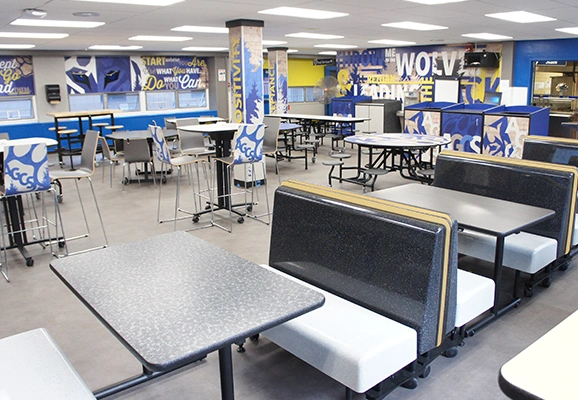
Quiet Focus Zones: where individual students can read, write, or think without the noise of a group project nearby. Lenoir soft seating paired with Blueridge shelving creates exactly this kind of welcoming, focused corner.
Technology and Charging Zones: built around device use, not fighting against it. Tables with accessible power, configurations that support laptop work, and comfortable seating that keeps students productive for a full class period.
Social and Casual Zones: the spaces that make a media center feel like a destination rather than a requirement. Palmer Hamilton’s Hive Lounge and Tahoe lounge collections are modular and reconfigurable, giving these zones the warmth and flexibility that invites students to stay.
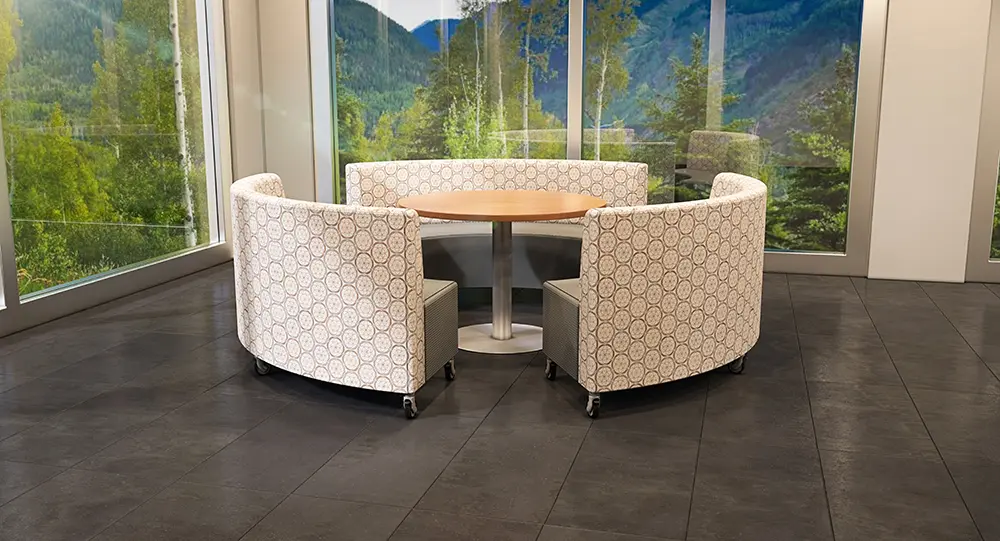
 Shelving Scaled to Your Collection: not the footprint from 2005, but one that reflects the collection you actually have today. Palmer Hamilton’s Blueridge shelving offers straight and curved configurations, single and double-sided units, designed for school environments. Right-sizing the collection frees up floor space for the zones your students actually need.
Build a Phased Plan That Fits Real Budget Realities
Not every school can renovate a media center in a single summer. Budget constraints, construction timelines, and operational needs often mean a full renovation happens in stages across two or three years.
That is not a problem as long as you plan the phases before you start. The worst outcome is a media center that looks like a renovation that got interrupted. Each purchase made independently, without a unifying vision for what the finished space will become.
Start with the zones that will have the most immediate impact on student use. In most schools that means the collaborative zone and the technology zone. These are the areas where the gap between what students need and what the space currently offers is widest.
Phase the soft seating and social zones in year two. Update the shelving footprint as the collection is right-sized in year three.
A Palmer Hamilton sales partner can help you build a phased plan with furniture selections and configurations that work together across all phases. So the space looks intentional at every step, not like furniture that arrived from different sources at different times.
Involve Your Stakeholders Before the Furniture Arrives
Media center renovations have a way of surfacing disagreements that were quietly simmering. The principal who wants a computer lab. The teacher who wants a quiet study space. The media specialist who wants a makerspace. The student who just wants somewhere comfortable to sit.
These are not competing goals. A well-designed learning commons can serve all of them. But you need that conversation to happen before the furniture arrives. Not after.
Bring the key stakeholders together at the zone-mapping stage. Let the media specialist lead the instructional vision conversation. Give the facilities director input on durability and maintenance requirements. Give students a voice in what a welcoming space actually looks and feels like to them.
The schools that do this well report that the renovation becomes a point of pride for the whole community because everyone feels like they had a hand in shaping it.
Choose a Partner Who Understands K-12
A learning commons renovation is not a catalog purchase. It is a space planning project, and it requires a partner who understands how K-12 environments actually work. Not just a vendor who ships furniture.
Palmer Hamilton has helped schools build and renovate media centers and learning commons across the country. The team understands the durability demands of institutional daily use, the budget realities of K-12 procurement, and the instructional goals a great media center is designed to support.
Explore Palmer Hamilton’s design services for full space planning, 3D renderings, and installation-ready designs. Or start with a conversation with a sales partner about your specific space and timeline.
Ready to Turn Your Media Center Into a Space Students Actually Want to Be In?
Connect with a Palmer Hamilton sales partner: palmerhamilton.com/sales-support/
Explore media center solutions: palmerhamilton.com/spaces/media-centers/
Explore Blueridge Shelving: palmerhamilton.com/product/blueridge/
Explore Chariot™ Booths: palmerhamilton.com/product/chariot-booths/
Explore Hive Lounge and Tahoe: palmerhamilton.com/product-category/soft-seating/