Are Wall Pocket Cafeteria Tables Banned in Canada? Understanding the Facts and the Building Codes

If you’ve heard that wall pocket cafeteria tables are off-limits for Canadian schools, you’re not alone. This persistent rumor has caused confusion for facility planners and architects across the country. The truth? There’s no ban, and there never was. Let’s walk through what Canadian building codes actually require and how to move forward with confidence.

Quick Answer: Are Wall Pocket Cafeteria Tables Banned in Canada?

Wall pocket cafeteria tables are NOT banned in Canada and never have been at the national level. There is no clause in the National Building Code of Canada (NBC) that prohibits wall-mounted or wall pocket cafeteria tables as a product category.

When properly specified and installed, wall pocket tables can be fully compliant with Canadian codes for K–12 and institutional projects. The systems are found in schools across the country today, supporting flexible dining and multi-use spaces.

The confusion around this topic typically stems from local interpretations or individual project decisions, not from any national prohibition. If you’re a school facility planner, architect, or administrator, you can proceed with wall pocket solutions knowing the code supports them when designed correctly.

What People Are Hearing: The “Ban” Rumor Around Wall Pocket Tables

Many Canadian school districts and design teams have heard some variation of “wall pocket tables are banned” or “you can’t use those anymore.” It’s a concern that surfaces regularly, during new school builds, cafeteria renovations, or safety audits led by local inspectors or consultants.

This perception can delay projects or push teams away from space-efficient solutions that would otherwise serve their students well. When a rumor gains traction, it’s easy for people to assume there must be truth behind it.

At Palmer Hamilton, we’ve heard this concern from Canadian partners. It prompted us to take a careful look at the actual codes and local practices. What we found is that the “ban” simply doesn’t exist in the way it’s been described.

Let’s examine the real requirements together, because understanding the facts means you can make better decisions for your school community.

No National Ban: How the National Building Code of Canada Actually Works

Canada has never adopted a national ban on wall pocket cafeteria tables. The NBC does not list or prohibit specific furniture products of any kind.

The National Building Code of Canada is published by the National Research Council and serves as a model code. Provinces and territories adopt and adapt it into their own provincial building codes, which then become enforceable law in those jurisdictions.

The NBC focuses on performance and life safety, fire safety, structural integrity, and means of egress, rather than naming or banning particular table types. This performance-based approach allows for innovation and flexibility in design.

Provincial and territorial codes, such as the Ontario Building Code, BC Building Code, and Alberta Building Code, are generally based on the NBC and follow the same approach. They set safety requirements rather than creating product blacklists.

Authorities having jurisdiction (AHJs) local building and fire officials, enforce these codes at the project level. This is where interpretations can vary from one municipality to another, which helps explain why some teams have encountered resistance on specific projects.

Wall Pocket Tables

Key Life Safety Priorities in Canadian Codes

Canadian building codes focus on several core life safety priorities:

  • Fire resistance of assemblies and finishes, including flame-spread ratings for interior materials

  • Occupant load calculations, travel distances, and exit capacity for the space

  • Clear egress routes that remain unobstructed at all times

Furniture, whether it’s a mobile cafeteria table, a fixed bench, or a wall-mounted system, is evaluated based on how it affects these factors. The code doesn’t care about the brand or product category. It cares about safety outcomes.

Local fire departments and building officials use the NBC and provincial codes as their reference point when reviewing school dining spaces. Their job is to ensure students can exit safely in an emergency, not to favor one table style over another.

Typical Compliance Considerations for Wall Pocket Tables in Canada

When architects and facility planners evaluate wall pocket systems, they should consider these high-level design checks:

  • Confirm that tables, in both open and closed positions, do not reduce required exit widths below code minimums

  • Verify that wall pockets do not intrude into rated corridors or exit passageways beyond allowed projections

  • Coordinate with fire alarms, sprinklers, and detectors so the pocket and table location do not interfere with life-safety systems

  • Ensure manufacturer data, installation instructions, and shop drawings are included in permit and review packages

When these standard checks are followed, wall pocket tables function like any other code-compliant built-in furnishing. The processing of permits should proceed smoothly when documentation is complete and thorough.

Why Wall Pocket Cafeteria Tables Are Code-Compliant When Properly Designed

Wall pocket cafeteria tables are wall-mounted systems where the tabletop and benches fold vertically into a recessed pocket or cabinet built into the wall. They’re common in K–12 cafeterias and multi-use spaces across North America.

When retracted, these units can free up significant floor area for assemblies, physical education, and community events. This flexibility is why schools choose them, allowing a single room to serve multiple purposes throughout the day.

From a code perspective, wall pocket tables offer distinct advantages:

Egress benefits when stowed:

  • Tables fold flush or near-flush against the wall, expanding clear egress widths

  • Floor obstructions are eliminated during events requiring open floor space

  • Emergency exit paths can be maximized during assemblies

Compliance when deployed:

  • Tables function like standard cafeteria tables seating when in use

  • Layouts can be designed to respect required aisles and exit paths

  • Proper anchoring and hardware are engineered to meet load requirements

Palmer Hamilton designs wall pocket systems with attention to clearances around exits and corridors, hardware that securely locks tables in the pocket, and the durable construction needed for daily school use. These details matter for both safety and longevity.

Like any built-in system, compliance depends on correct specification, installation by qualified professionals, and accordance with the local AHJ’s direction. A well-designed installation creates storage that disappears when you need the space and reliable seating when you need to serve meals.

Wall Pocket folded into the wall

So Where Did the “Banned in Canada” Myth Come From?

Rumors usually start from real experiences, like a project where an inspector requested changes, then spread without the full context. Over time, a single project issue can transform into “this is banned everywhere.”

Several likely sources explain the confusion:

Local inspector interpretations: An authority having jurisdiction may have required a specific installation to be modified because it narrowed an exit corridor or conflicted with a fire safety requirement. That project-specific request could be retold as a broader prohibition.

Individual school board policies: Some boards may choose not to use certain table types for operational or maintenance reasons. A policy preference isn’t the same as a code requirement, but it can be misinterpreted when passed along.

Provincial variations: Provinces and territories can adopt additional requirements beyond the NBC. A stricter local clause might be generalized into “this is banned everywhere in Canada.”

Consider this example: a wall pocket table project might be rejected because the pocket was poorly located near an exit door, or because outdated hardware didn’t meet current lock requirements. The rejection was about that specific installation, not about wall pocket tables as a category.

None of these situations constitute a national ban. Well-conceived wall pocket solutions continue to be delivered and installed in Canadian schools and institutions. The variety of successful projects across provinces demonstrates that these systems are allowed when done right.

Miscommunication Between Policy and Code

Sometimes an internal facilities guideline like “we prefer mobile tables only” gets retold as “wall pocket tables are not allowed by code.” The original policy had nothing to do with legal requirements, it was simply a district preference.

It helps to distinguish between:

  • Legal requirements: Building and fire codes that must be followed

  • Local board standards: Design manuals and operational preferences that guide decisions

  • Project-specific decisions: Choices driven by budget, existing conditions, or maintenance considerations

When you hear “not allowed” on a project, ask specifically: “Is this a code issue or a local policy?” The answer will change how you respond.

School boards and code officials share the same goal, keeping students safe. Early dialogue creates room for collaboration rather than confusion. A request for information isn’t an obstacle; it’s an opportunity to demonstrate compliance.

Practical Guidance for Canadian School and Institutional Projects

If you’re considering wall pocket cafeteria tables for a Canadian project, here’s a practical checklist to keep things moving smoothly.

Early coordination steps:

  • Engage the authority having jurisdiction (building and fire officials) early in schematic design to discuss wall pocket concepts

  • Share manufacturer data sheets, dimensions, and operation descriptions in preliminary code reviews

  • Confirm required exit widths, travel paths, and clearances for the specific occupancy and room size

  • Create a ticket system for tracking questions and responses from officials

Design best practices:

  • Locate wall pockets on non-egress walls wherever possible to keep exit routes clean

  • Use layouts that maintain clear aisles and direct paths to exits when tables are deployed, this may mean more personal space between seating positions

  • Consider daily operations and how staff will fold, stow, and secure tables to maintain compliance in real use conditions

  • Ensure personal space requirements are met for students on both sides of the table

  • Think about how the box of the pocket integrates with wall finishes and adjacent elements

Documentation to prepare:

  • Manufacturer specifications showing load ratings and flame-spread classifications

  • Shop drawings indicating clearances to exits, corridors, and fire protection equipment

  • Installation instructions that will be supported by qualified contractors

When customers approach projects this way, compliance becomes a design collaboration between the school, architect, code officials, and manufacturer, not a barrier to overcome.

Working with Palmer Hamilton on Canadian Code Questions

Palmer Hamilton has been designing school dining environments since 1941. We regularly support projects across North America, including Canadian provinces from coast to coast.

Here’s what our team can provide:

  • Pre-design consultations on wall pocket versus mobile table strategies for your specific space and operations

  • Layout recommendations that balance seating capacity, circulation, and egress requirements

  • Documentation packages that help streamline code and permit review for your AHJ

  • Technical guidance on load data, installation requirements, and provincial considerations

We’re committed to creating long-term, safe, and flexible environments that support student learning, collaboration, and community events. Whether you’re planning a new build or a renovation, we can help you learn what approach fits best.

Our experience across thousands of school projects means we’ve seen the questions that come up, and we know how to address them. When you need to ensure compliance while making the most of your available room, that experience matters.

Palmer Hamilton: A Trusted Partner for Safe, Flexible Cafeteria Design

Wall pocket cafeteria tables are not banned in Canada. When thoughtfully designed and correctly installed, they meet Canadian building code requirements and support highly flexible dining spaces. The myth shouldn’t stop you from exploring a great solution for your school.

Since 1941, Palmer Hamilton has focused on educational, institutional, and collaborative environments across North America. We build products that are durable enough for daily use and designed to create spaces where people connect. Safe, adaptable cafeteria and commons spaces help schools serve meals efficiently, host events, and foster the kind of environment where students and staff thrive.

We approach every project with a code-aware, solutions-first mindset. Working alongside architects, facility leaders, and authorities, we get the details right so you can move forward with confidence. That’s what it means to be a trusted partner, not just today, but for the life of your project.

Call to Action: Plan Your Next Canadian Cafeteria Project with Confidence

Ready to explore wall pocket cafeteria tables for your Canadian school or institutional project? Contact Palmer Hamilton to start the conversation.

We can help you determine whether wall packet systems are the right fit for your space and daily operations. 

Don’t let rumors delay a project that could transform how your school uses space. Together, we can create safer, smarter, and more flexible cafeterias that serve your community for decades to come. Touch base with us today, and let’s build something great.

Our Tables Have Great Legs to Stand On

Schools that purchase tables from Palmer Hamilton have no shortage of customization options for layout and design. Ironically, this multitude of possibilities for the customer starts out with a standardized, repeatable engineering process developed through decades of experience in the K-12 furniture market with three factors that have proven to deliver quality products: safety, functionality and efficiency.

Safety

The first and most uncompromisable priority in a Palmer Hamilton table design is safety. Designing safe products for K-12 comes with some unique challenges, as the tables are often moved and treated rougher than other environments while their primary users, children, are more accident-prone than adults and therefore more susceptible to injury.

In response to these risk factors, all Palmer Hamilton tables come with several safety features to protect both the products and the people who use them. Palmer Hamilton tables aren’t just nice to look at; they’re built to last. We offer industry-leading durability with a 15-year warranty to give schools confidence in their investments’ longevity.

To protect the students and staff who interact with our products, we follow table construction guidelines and certain safety tests that have been cemented as industry standards. However, we also incorporate our own experience in K-12 to identify potential risks and add additional safety features. This includes locking mechanisms to ensure tables are stabilized during use and storage, outriggers to allow them to be moved and stored safely and inherent features to prevent pinch points.

Functionality

Defining the function(s) is the first step we take when coming up with a new product. Developing a novel table model is always exciting, but doing so without first identifying a corresponding need is essentially a waste of time.

In addition to understanding the market to find that need, companies have to understand themselves and their offerings. There may be a new, in-demand function that can be fulfilled with a few small tweaks to an existing model. Self-awareness in this kind of situation allows companies to streamline the engineering process to expand their capabilities efficiently.

After identifying what the function is for a new table, designers need to anticipate how it will be used. People are increasingly placing value in ease of use for most products, and that rings true for K-12 furniture. Any necessary setup, takedown or movement to achieve the desired function should be easily done without complicated instructions.

Efficiency

The final critical priority in developing a new table is efficiency. Adding a new product means more work to the production line, which makes simple assembly processes critical to the operation’s sustainability. Efficiency on the floor can also be achieved by consolidating existing products. In 2023, the

Palmer Hamilton team reviewed our line of mobile cafeteria tables with an assessment of how the offerings fulfilled different functions. We found that the number of complex assemblies could be reduced by 50 percent while still covering all the needs schools may have. This reduction eliminated redundancies in the catalog and streamlined the production process to be more economical.

As Palmer Hamilton continues to grow, we anticipate continued challenges in maintaining efficiency and new opportunities to find innovative solutions. For now, our priority is investing in our people, as they are the foundation of our current and future success. We are also exploring new technologies and automation that can elevate our operation even further. The future looks bright, and we are excited to continue developing tables that help schools do more with their space.

How Palmer Hamilton Puts Our Knowledge to Work for You

After so much time working in K-12 schools, we have learned a great deal more than English, math and science. Doing business with a school district is unique from most other partnerships, and being able to navigate that successfully requires in-depth knowledge and a well-rounded approach focused on school-specific ease of business.

A Basic Education on Education

Timing is important in any project, regardless of the industry. However, the window for completing a project within a school makes timing even more critical. The budget year in education typically begins on July 1, which tends to be 6-8 weeks before the start of classes. This usually results in planning done throughout the school year for any larger projects to be completed in the following summer before the next fiscal year. With such little time available, businesses working with schools need to be efficient with responsive quotes, easy-to-place orders and a full understanding of the timing required for development and installation to not interfere with school operations.

Each cafeteria project Palmer Hamilton has worked on over the years is unique, but we’ve been able to separate most of them into three major categories to help us budget our time properly.

  1. The school wants to replace old tables. This tends to be a simple discussion with the school decision makers and does not involve much added design work.
  2. The school wants to convert a space into a multipurpose community room. These projects are more complicated, with different types of furniture and design elements to complement the multievent space.
  3. The school wants to completely upgrade the cafeteria. A project like this involves collaboration with several stakeholder groups and a considerable amount of time planning, designing and installing.


Making the Grade

To ensure the best flow of business for these and any other styles of project, Palmer Hamilton has invested significantly into business process improvements across our operation.

A major enhancement comes from reinvesting over $5 million into our manufacturing capabilities. We were able to add high-tech equipment that allows us to insource much of what we were previously outsourcing, simplifying the process and reducing lead times.

In addition, we integrated our enterprise resource planning (ERP) system with our customer relations management (CRM) system. Not only does this make digital project components less complicated, it also allows for full transparency with customers who can track their order and easily communicate with us about its status. The CRM system has also been upgraded to include case management for any issues or questions customers may have during the project or after it’s installed. As a result of this new software, the number of cases that are open and the average time it takes to close them has decreased by 50% in only eight months.

Customer interactions have also been made easier with our new Quick Pick form. This tool gives schools access to a selection of our most popular products and colors to build an initial design concept. Our team can then take that concept as a jumping off point, streamlining the process of obtaining customer input for designs and quotes. The next evolution for this resource is to enable images to be moved or rotated and add more color options and interactive features for our customers.

These changes have had a major impact on the ease of doing business with Palmer Hamilton, and we’re just getting started. We refuse to rest on our laurels and remain committed to delivering industry-leading products with industry-leading customer service.


Palmer Hamilton Designs Cafeterias with Taste

Is your school cafeteria providing the student experience you want?

When it comes to educational environments, Palmer Hamilton is here to help you to do more with your space™. Our experienced, accredited interior design experts are collaborative, easy to work with, and eager to bring tangible results to your school through a proven process, innovative design, and durable furnishings.

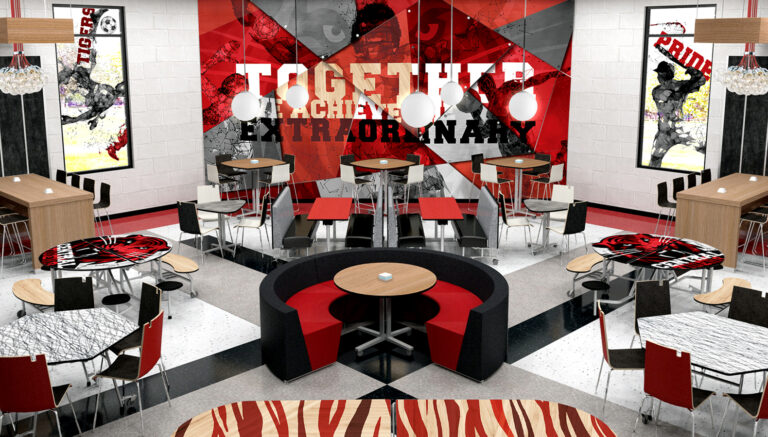
If you’re looking to transform your school lunchroom into a sleek, modern food court that students will be excited to use, our PHDesign Team is ready to help you create dynamic, flexible environments that engage students.

PHDesigners Collaborate and Communicate

Palmer Hamilton prioritizes collaboration and communication with all key stakeholders-students, teachers, school administrators and school boards, and even community members. We also work with any third-party collaborators as well.

We offer a variety of design options to fit exactly what you’re looking for in your project. Our processes begin with project intake-a comprehensive analysis of your existing space beginning with measurements and considering the electric, plumbing, and technological needs required for the overall design and plan. Our conversations with you also include gathering information around objectives, milestones, and of course budget.

Using these assessments, our PHDesigners work closely with your team to ensure all essential elements of your new space we’re looking to create are accounted for. This part of the process is highly collaborative to allow PHDesigners to fully understand the vision. Our designers use immersive, personal insight so the space can best represent school pride, account for accessibility needs, and more. If you are undertaking a new build, our PHDesigners support the architects to bring your vision to life.

Following these conversations, PHDesigners produce renderings and 3D room perspectives to ensure we have fully met your expectations with details down to the exact color you picked for your chairs. With your approval, the process for ordering and installation begins.

Your Fruits, Our Labor

Transforming a school lunchroom brings a vast array of benefits. A reimagined cafeteria or a refreshed food court can become a source of school pride and community with a design that encourages students to come to school and engage with one another in these sleek, modern environments.

When a food court becomes a social hub, it boosts belonging and identity. Instead of a place to eat lunch, it becomes a spot to share a meal with friends and peers, and a source of excitement for students. Streamlined, optimized lunch lines provide a better student experience with a more controlled environment for school nutrition staff and faculty.

One of the most tangible benefits a cafeteria transformation delivers for school administrators and school boards is an exceptional ROI. New food courts, on average, increase overall participation in school lunch program participation by 15%. Engaging students with nutritious meals allows for better learning outcomes.

Results You Will Feel

One of the most rewarding elements of cafeteria transformations is seeing how they benefit everyone-not just the students using the spaces, but the faculty and staff, and families as well.

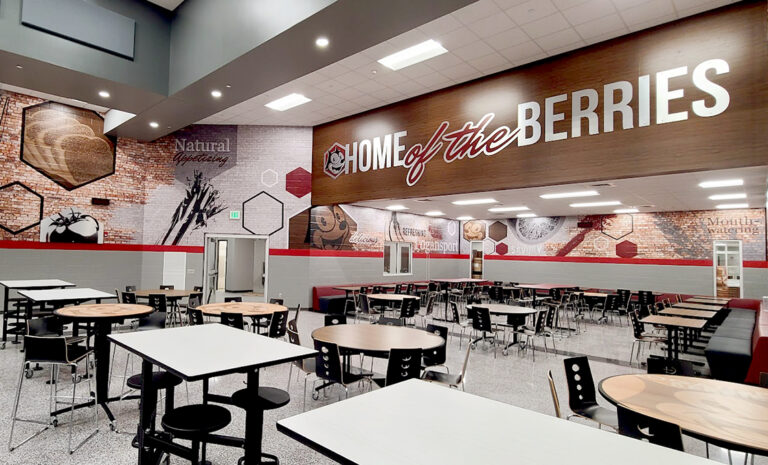
PHDesigners visited Pixley Middle School in California in June to help them do more with their cafeteria space. This new installation offers markedly different lighting, color, and flow. With incorporated school colors and logos, the space feels alive with tables of varying shapes and sizes.

Morehouse Elementary in Louisiana and Connersville Middle School in Indiana enjoy their transformed spaces. PHDesigners create spaces that reflect the unique interests of students by incorporating insights from the people who know them best: the school faculty and staff.

Looking to transform your school cafeteria? Reach out to Palmer Hamilton, and we’ll help you do more with your space™.


Hawaii

Sales Representatives

Ty Maras
CRO – Palmer Hamilton LLC
tmaras@palmerhamilton.com
1.800.788.1028 ex. 903
Or see Teri Wilson-Ruggles

Teri Wilson-Ruggles
Director of PHDesign
truggles@palmerhamilton.com
1.920.517.7809
Or see Ty Maras

Customer Experience Representative

Aimee Duchemin 
aduchemin@palmerhamilton.com
1.262.274.4916