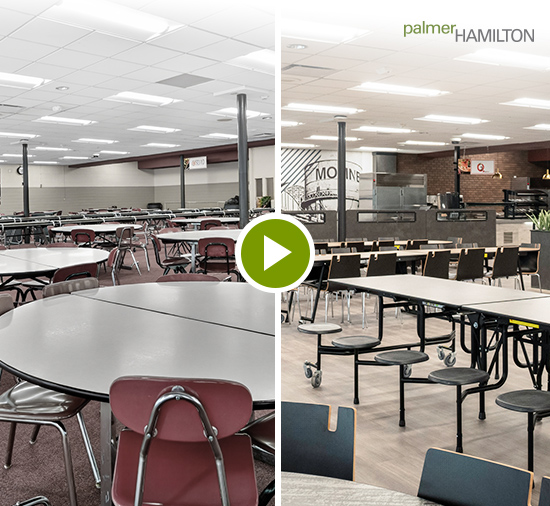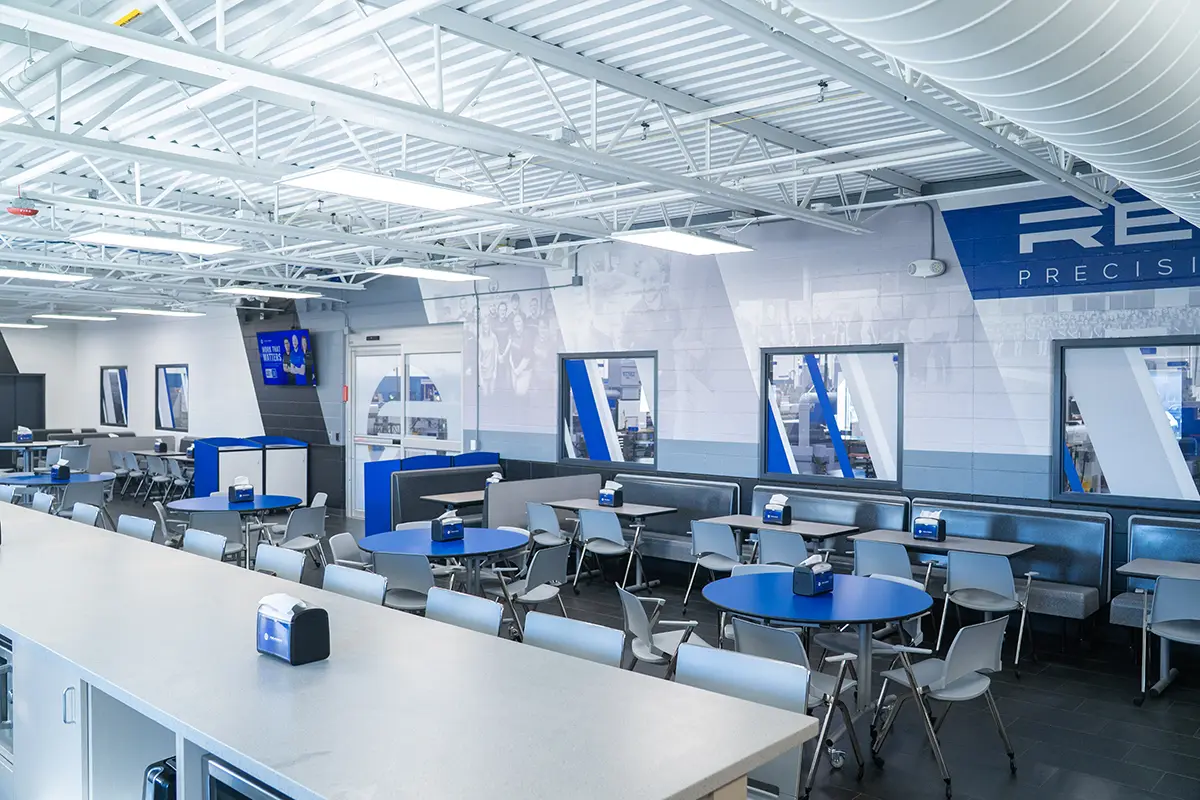
Plant managers will tell you the worst room in their facility is the break room. Scratched tables pushed against the wall, mismatched furniture, seating that has not been updated since the original build-out, no clear flow, no place to decompress. When the room where your team spends their break looks like it was never given a second thought, it conveys exactly that. You do not care about the place where your workers retreat to recover.
If your people would rather sit in their cars during break than walk into that room, that is saying something. It is saying they would rather be anywhere else. Anywhere. Than in your place.
If you want to see the value a company places on its employees, look at the break room. The companies that invest in the design and upkeep of their facilities are the ones that genuinely care. They are the standout operations, and their workforce knows it.
The Break Room Is a Performance Decision
A manufacturing break room is not a perk. It is a recovery zone. Workers in physical roles need genuine mental and physical decompression between shifts and during breaks. When the space does not support that, people do not recover as fully. They return to the line less focused, more fatigued, more prone to errors.
The design of that room, the layout, the furniture, the flow, determines how much real recovery actually happens in the time available. That makes it a production decision, not a facilities decision.
What the Data Actually Says
The connection between break room quality and employee engagement is well documented in real organizations. Mesirow Financial, a Chicago-based financial services firm, updated their break room specifically to attract and retain talent. According to their facilities manager, the renovation created a greater sense of community among employees and drew people from different departments to mix and interact in ways they were unable to before. That is not a soft outcome. That is a culture shift, driven by a room.
The numbers support it at scale as well. A 2023 workplace survey found that 80% of employees said a quality break room improved their happiness at work, and 67% reported higher productivity when they had access to good break room facilities. Those are not small margins. For a manufacturing floor where focus and output are everything, those numbers matter.
And when workers are deciding where they want to build a career, physical environment factors into the equation. Gallup reports that workers across generations rank an organization that cares about employees’ well-being in their top three criteria when evaluating employers, and it is the top benchmark for Millennials and Gen Z. The break room is one of the most visible expressions of that care. Or the absence of it.
Start With the Shift Overlap, Not the Headcount
Most facilities design break rooms around total headcount. That number is almost always wrong for this purpose. What matters is how many people will be in the room simultaneously during peak overlap periods, and what they need to do in that time: eat, sit, recharge, have a quick conversation, or find a few minutes of quiet.
A 300-person facility where breaks are staggered across three shifts may only need to seat 40 people at once. A 120-person facility with synchronized break schedules might need to seat 80. Design for the peak moment, not the building total.
Zone the Room Around What People Actually Do
- Dining zone: for eating and group conversation. This is the high-energy social area where most of the room’s seating lives.
- Quiet zone: for people who need lower stimulation between demanding shifts. Positioned slightly apart from the main dining area with minimal ambient noise.
- Transition zone: near the entrance, where people grab coffee, check phones, and move through quickly without blocking seated workers.
Note: These zones do not require walls or major construction. Furniture placement, seating height variation, and strategic use of surfaces can create clear functional areas within a single open footprint.
Choose Furniture That Survives the Environment
Manufacturing environments are hard on furniture. High-traffic rooms with workers in work clothes, steel-toed boots, and sometimes grease or residue from the floor need surfaces that clean quickly and frames that hold up to daily movement and use. Upholstered seating that cannot be wiped down, or laminate table surfaces with exposed edges, will show wear within months.
Palmer Hamilton designs furniture specifically for high-use environments. Table frames, edge profiles, and surface materials are chosen for durability in conditions that would destroy standard commercial furniture within a year. That is not a feature. It is the baseline requirement for this application.
The Proudest Facilities Are Planned, Not Just Furnished
There is a difference between a room that has furniture in it and a room that was designed. The facilities that treat their break rooms as an investment in their workforce end up with spaces people actually want to spend time in. That matters for retention. It matters for morale. It matters for what happens on the production floor in the hour after that break ends.
Your break room does not have to be the room everyone apologizes for. Start with the layout, design around the peak moment, zone for behavior, and specify materials that belong in a manufacturing environment.
Palmer Hamilton can help you get from the room you have to the room your team deserves. Talk to our team about what the right solution looks like for your facility.