Durability, Design, and Budget-Smart Solutions for School Dining Spaces
Most districts replace cafeteria tables once every ten to fifteen years. That means most facility managers are making this decision infrequently, with a committee watching, and a budget that draws a lot of input.
This is a practical guide to reviewing cafeteria table options. It covers the questions worth asking, the features that actually matter in a high-volume school dining environment, and the cost factors that drive every quote. The goal is to provide clear, usable information so you can make a confident, defensible ten-year decision.
Start with Pricing Context, Because It Matters
Most vendors make you sit through a product demo and a follow-up call, and then wait even longer, before telling you what anything costs. That is not how we operate, and it is not how school buyers want to work.
K-12 cafeteria table pricing is driven by five main factors:
- Table size and shape (rectangular, round, or activity style)
- Top material: laminate, solid surface, or stainless steel for food service environments
- Seating style: attached benches, detached benches, chairs, or stools
- Mobility features: folding frames, mobile bases, or fixed configurations
- Finish and color customization options
As a general rule, a straightforward laminate top table with attached benches is often the most cost-effective and widely used option. Mobile folding tables with premium solid surface tops and custom colors tend to increase the overall cost.
Stats You Need To Know
- 71% of school leaders say cost is the top factor in purchasing decisions in 2026.
- 68% of buyers prefer pricing context before the first meeting.
- 10-15 yrs is the typical lifespan of a school cafeteria table, making it a long-term facilities investment.
Types of K-12 Cafeteria Tables: What Each One Is For
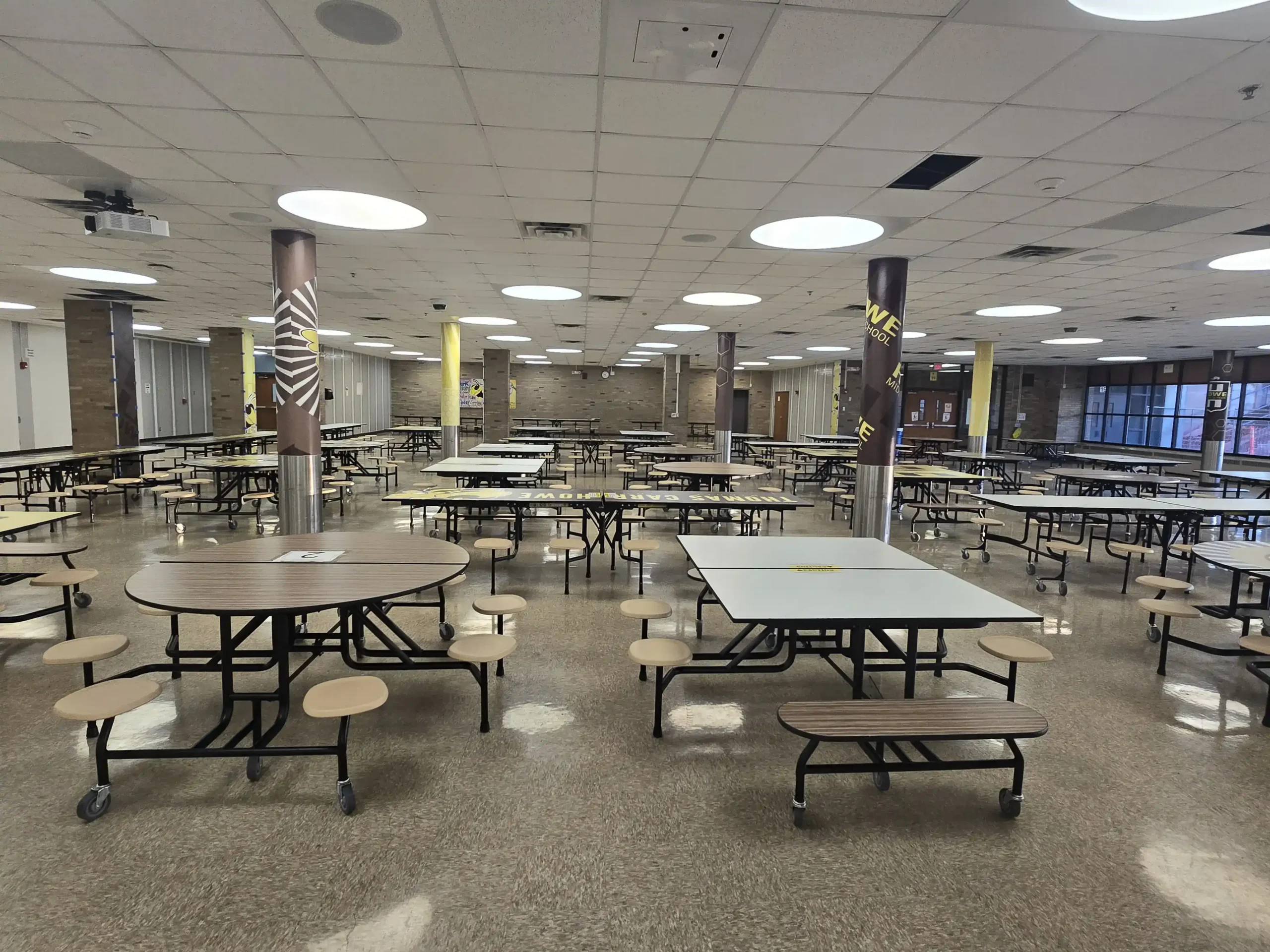
Not every table works in every cafeteria. Here is a clear breakdown of the most common configurations and where each one earns its place.
Rectangular Tables with Attached Benches
The most common choice in K-12. Attached benches maximize seating density, simplify storage, and eliminate the chair management problem that plagues every lunch period. These are the workhorses of the school dining room, and Palmer Hamilton has been building them for 75 years.
Rectangular Tables with Detached Seating
Detached chairs or stools give students more flexibility, work better for older grades, and make ADA accommodation easier in some layouts. The trade-off is more pieces to manage and more floor space required per seat.
Round Tables
Round tables change the social dynamic of a lunch period. They work well in elementary settings where eye contact and conversation matter, and they tend to reduce the long-bench problem where students at the ends feel isolated. Smaller footprint configurations also fit tighter spaces.
Folding and Mobile Cafeteria Tables
If your cafeteria doubles as an auditorium, a testing center, or a community event space, mobile and folding tables are not a luxury; they are the only configuration that makes the room work for everything your schedule demands. Look for tables that fold and move with a single staff member, not a crew.
Booth and Bench Seating
Booth seating and fixed benches create defined zones in a larger dining room and tend to hold up well in high-traffic areas. They work especially well along perimeter walls or in areas you want to anchor as quiet or small-group dining zones.
Durability: Built for a Room That Never Really Stops Moving
A cafeteria table gets sat on, leaned on, bumped by trays, and cleaned multiple times a day, every school day, for ten or more years. Durability should be considered a baseline requirement. Here is what to look for.
| Feature | What to Look For |
| Frame construction | Welded steel |
| Leg glides | Protective glides that will not scratch floors and can be replaced when worn |
| Top rating | Rated for heavy commercial K-12 school use |
| Bench support | Continuous bench support rails for maximum durability |
| Hardware | Stainless steel or coated fasteners that stand up to daily use |
| Finish | Powder coat paint for durability |
| Warranty | A longer warranty that provides reliable, worry-free protection |
Easy Cleaning: Because Food Service Does Not Pause for Furniture
Your custodial team cleans these tables between every lunch period, sometimes with five minutes to work with. Surface and construction choices have a direct impact on how long that takes and how clean the room actually gets.
Surface Options for Food Service Environments
- Laminate tops resist stains, clean quickly, and are commonly used in K-12 settings. High-pressure laminate rated for food service holds up to repeated cleaning with school-safe sanitizers.
- Solid surface tops are more resistant to heavy scrubbing and chemical sanitizers and are often used in higher-traffic environments.
Beyond surface material, pay attention to edge sealing and joint construction. Gaps and unsealed edges collect food debris and harbor bacteria. Attached seating with smooth, sealed edges reduces the cleanup time per table, which adds up across a full dining room and a full school year.
What to Know About Dark Solid Colors
Dark solid laminates look sharp in a freshly cleaned room. They also show more. With no pattern to break up the surface, fingerprints, light residue, and small scuffs are more visible on a dark solid top than on a patterned or lighter one. The material is not less durable, and it cleans the same way with a soft cloth and mild soap. It just reads busier at the end of a lunch period.
Two specification choices make marks less noticeable on a dark top:
- Matte and textured finishes show scratches less than a smooth gloss.
- Solid core laminate carries the color through the full thickness of the material, so chips and edge wear do not expose a light line along the edge.
Ask your rep to walk you through both before you finalize a dark color.
ADA Compliance and Seating Capacity: Plan Them Together
ADA compliant seating should be planned as part of the overall layout, not added after the fact. It is part of how you lay out the room from the beginning, and the best table lines build accessible configurations into the same product family so accessible spots do not feel segregated.
What ADA Compliance Looks Like in a Cafeteria
- Open-end or removable bench sections that allow wheelchair positioning
- Knee clearance of at least 27 inches under the table surface
- Table height between 28 and 34 inches for accessible seating positions
- Integrated configurations that look like the rest of the room, not an afterthought
Seating Capacity is Really Traffic Flow Planning
“How many seats can you fit in the room?” is the wrong starting question. The right questions are: How do students move from the serving line to a seat? How does the room clear during a lunch period? How quickly can tables be cleaned and reset for the next group?
A room with slightly fewer seats but a clear traffic flow pattern will move students faster and reduce discipline problems during lunch transitions than a packed room where students are shoulder to shoulder and movement is difficult.
Mobile and folding table options give you the ability to reconfigure for testing, assemblies, or community events without buying a second set of furniture for the room.
For complete ADA compliance requirements, visit ADA.gov
Maintenance: What Your Facilities Team Will Thank You For
A ten-year table only stays a ten-year table if maintenance is manageable. Here is what experienced facility managers wish they had asked before buying.
- Replacement Parts Availability: Ask how leg glides, bench hardware, and mounting brackets are sourced. Parts should be available from the manufacturer, not a third-party supplier that may discontinue them.
- Bench Replaceability: A cracked bench or a damaged top should be replaceable without buying an entire new table. Ask this question directly.
- Warranty Terms: Understand exactly what is covered and for how long, and whether warranty service is handled locally or requires shipping components.
- Cleaning Chemical Compatibility: Confirm that the top surface and frame finish are compatible with the sanitizers your food service team already uses. A table that requires special cleaning products adds ongoing cost and compliance complexity.
- Annual Inspection Needs: Some table configurations benefit from an annual hardware check, particularly folding and mobile tables with locking mechanisms. Ask what that looks like in practice.
The total cost of ownership over ten years includes the purchase price, any replacement parts, and the staff time your custodial team spends cleaning. A table that is 15% more expensive at purchase but takes half the time to clean may be the better financial decision.
Your Pre-Purchase Checklist: What to Confirm Before You Buy
This list is designed to survive the committee review, the business office questions, and the superintendent’s walk-through. Work through it before you finalize any quote.
| ✔ | Confirm Before You Buy |
| □ | Tabletops rated for commercial food service use, not light-duty laminate |
| □ | Seating style decision made: attached benches, detached seating, or mixed configuration |
| □ | ADA accessible configurations confirmed and built into the layout |
| □ | Mobility requirement decided: folding or mobile bases if the room doubles for events |
| □ | Finish and color options reviewed and matched to the school’s palette |
| □ | QuickShip availability confirmed if your required delivery timeline is shorter than the standard lead time |
| □ | Warranty terms reviewed in writing, including parts coverage |
| □ | Replacement parts availability and sourcing confirmed |
| □ | Cleaning chemical compatibility verified with food service team |
| □ | Pricing by configuration received in writing, before the first meeting |
| □ | Local sales partner identified for post-installation support |
| □ | Purchasing contract or cooperative pricing reviewed to simplify procurement |
Why a Cafeteria Upgrade Is the Most Visible Win in a Tight Budget Year
In a year when 1 in 3 districts expects budget cuts, every purchase needs a story that survives a board meeting. A cafeteria renovation has one of the best stories in the furniture category.
- No pilot period required. New tables go in over a break and are ready day one.
- No risk to instructional time. A cafeteria renovation does not touch a classroom, a curriculum, or a staff development calendar.
- The whole community sees it immediately. Students, staff, parents, and board members all walk through the cafeteria. A transformed dining room is one of the most immediate community-visible changes a district can make.
- Calmer lunch periods. A well-designed dining room with clear traffic flow and comfortable seating reduces the friction of lunch transitions, which matters to teachers who see the difference in how students arrive to afternoon classes.
- Pride matters. A dining space that feels cared for tells students something about how the institution thinks about them. That is not a soft benefit; it is a retention and enrollment signal.
Why Palmer Hamilton
Cafeteria tables are what Palmer Hamilton is known for. We have designed and built them in Elkhorn, Wisconsin, for over 75 years. That history shows up in every weld, every top surface specification, and every question our local sales partners know to ask before a quote goes out.
What Working with Palmer Hamilton Looks Like
- QuickShip Program: Select configurations are available with shorter lead times when your project schedule is tight.
- Purchasing Contracts: State and cooperative purchasing agreements simplify procurement and can eliminate weeks from the bidding process.
- Local Sales Partner Network: Work with a regional partner who knows your market, stays reachable after installation, and is accountable for the outcome, not just the order.
- More Than 75 Years of Cafeteria Expertise: Our specifications, configurations, and institutional knowledge are built on decades of K-12 installations.
Ready to talk specifics? Explore our cafeteria tables, bench tables, and booth and bench options, or connect with your local Palmer Hamilton sales partner for a quote built around your room and your budget.