Esports Past, Present and Future

Watch our YouTube series of Jeff Palumbo interviews.

Though it may not seem that way for people unfamiliar with online gaming, esports did not burst onto the scene overnight. The historical roots of modern esports stretch back for decades, and a series of gradual changes have all come together to create the industry we know today. Learning about these origins can help garner a deeper appreciation for esports, while also developing an understanding of where your program fits into its ongoing story.

Gaming’s Past

Organized esports’ beginnings can be linked with the invention of video games. From the early days in the 1970s, a large component of the appeal of games like Pong and Pinball was the opportunity presented to players to compete for the highest score. Gaming quickly became a social activity, where groups of friends could organize, gather and best each other in friendly rivalry.

About 10 years ago, game developers in South Korea and Japan began expanding on the community aspect of gaming with more robust, cooperative multiplayer capabilities. These advances exploded in the international market and created an entire industry around team-based esports, second only to soccer in its popularity as a competitive activity.

Our Present

With the growth in esports, K-12 and higher education schools have increasingly seen the value in offering students opportunities to explore that interest. In higher education, this is largely driven by admission and retention. Recent research has shown that while only about 30 percent of college freshmen have played a traditional sport, 90 percent have played video games. Dedicated esports facilities offer students the chance to engage with each other in a face-to-face atmosphere or participate on competitive teams instead of gaming individually from their room. When students find a community on campus, they are happier, healthier and more likely to find a reason to stay and flourish, which in turn helps the school financially.

In public K-12, where admission is more guaranteed, the appeal of launching an esports program is often the bridge it creates to essential life skills, health and wellness. Online gaming is a lot like social media. Players can connect with anyone in the world and communicate online with anonymity, which could produce negative interactions for young people still developing their social intelligence. Offering gaming in a supervised and secure environment allows students to explore interests and potential career paths while also developing healthy interpersonal skills.

Your Future

As esports programs continue to expand into school settings, they exhibit the same theme that drove developers to expand multiplayer capabilities in the gaming market: together is always better. The most important way to ensure success is to approach the set-up of an esports program by focusing on student success and working with partners who can apply those values from start to finish.

For a more expanded explanation of these concepts and details on how you can apply them to your own esports program, check out our video series.

Palmer Hamilton Launches Design Service for Esports Spaces in K-12 Schools

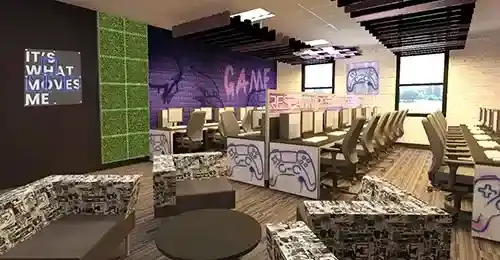
Palmer Hamilton, a full-service provider of turnkey furniture and design solutions specializing in K-12, has added esports spaces as an offering for schools featuring gaming chairs and desks designed by RESPAWN, a manufacturer of furniture designed for gaming.

Esports, or competitive video gaming, has had a growing presence as a team sport at the professional, college and now middle and high school levels. Esports’ popularity can be attributed to its appeal to a population of students who are not drawn to traditional extracurricular activities.

“We have found in our work with RESPAWN that most of the students who join an esports team do not participate in any other team activities,” says Palmer Hamilton CEO John Gardner. “Not only does an esports space allow these kids to find a community within the school, but the encouragement and development of an official program can help many of them find lifelong careers in the gaming industry.”

By incorporating the multiple lines of gaming chairs and desks offered by RESPAWN, Palmer Hamilton designers can expand their offerings to accommodate the growing demand for esports programs and spaces in K-12. Spaces incorporating new esports products and design services can be independent or incorporated into a new or existing STEM/STEAM lab.

Schools working with Palmer Hamilton on these and any other spaces are encouraged to involve key stakeholders, including faculty, staff and students, in the design of the project to create a space that reflects the unique character of the community. In addition to the new esports capabilities, Palmer Hamilton designers can work with schools to enhance cafeterias, media centers, STEM/STEAM labs and other common areas.

See our Esports Environments section for more information.


Making Room for Esports in Schools

At Palmer Hamilton, we strive to provide quality furniture and décor solutions that help K-12 schools do more with their space. Our true mission, however, is to deliver environments that encourage collaboration and give every student a place where they feel welcomed and supported.

This mission was the driving factor in developing Palmer Hamilton’s new partnership with RESPAWN, a supplier of high-quality furniture for esports. The esports industry has grown exponentially over the past few decades, and its influence has had an impact on K-12 schools with many schools adding video games as learning tools in curriculum and offering competitive esports teams as an extracurricular opportunity for students. As this presence continues to grow, having a dedicated space for esports can ensure that a new demographic of students finds a home within the school and resources they can use to find future success in a growing industry

Inclusion for Today


A 2019 survey taken by the Aspen Institute for Project Play, a non-profit that works to develop healthy communities through sports, found that in 2018 only 38 percent of kids ages 6 to 12 played a team sport on a regular basis with the average child quitting sports entirely by age 11.1 Esports players see even lower participation rates in sports. Through its work with the Wisconsin High School Esports Association (WIHSEA), RESPAWN has found that 80 percent or more of the members in most esports programs do not participate in another team activity.

For the majority of these kids, esports are a chance to reap the social, mental and emotional health benefits of being on a team that they would not traditionally find. According to Health.gov, these benefits can include lower rates of anxiety and depression, higher cognitive function and even a reduced risk of suicide.2 This makes driving participation and supporting those who are already involved in esports an important responsibility for school administrations.

Getting students excited about esports starts with creating the right environment. A basketball program would not thrive if the playing space consisted of an outdoor, concrete court with a portable hoop. Players want a proper court with team colors on the walls, equipment they are excited to use every day and school pride exhibited throughout the space.

Esports is the same.

Many students who would be interested in joining an esports team likely already have a setup at home. Schools that develop an esports space with companies like Palmer Hamilton and RESPAWN offer replicated or even elevated performance spaces to invite student participation. School imagery can also be incorporated throughout the space to foster the pride and belonging that come with participating in an organized team activity for kids who may not always see themselves as representatives of their school’s spirit.

As schools embark on developing an esports space, Palmer Hamilton encourages them to consult with all stakeholders, including the students who will use it. Not only does this help them take further ownership of the space, but it also offers an opportunity for input from people who may want to get involved but are hesitant due to lack of representation. This is especially pertinent for young women. Though esports has become more even in the gender makeup, the population is still largely male dominated. Inviting women and students from other non-majority demographics to make their mark on the space from the beginning helps give everyone who wants to participate a welcoming environment.

Careers for Tomorrow

In many cases, the activities that kids participate in during their days in K-12 are much more than fun ways to pass the time. Thousands of former high school athletes are now playing professionally, coaching or finding other ways to turn their passion into a lifelong career.

An interest in esports opens the door to more career opportunities than almost any other school activity. Market Watch reported in 2021 that the video games industry grew to surpass the combined market share of both film and North American sports, and the jobs in this massive enterprise are both numerous and lucrative.3 Having the resources and support for students can help them find and build careers they are passionate about.

Esports spaces can also be part of a larger effort to encourage students in STEM/STEAM fields. Having a full room dedicated to esports in the school would be ideal but may not be viable with budget and space constraints. Instead, schools can work with brands that specialize in STEM/STEAM, such as PHabLab, to create multi-purpose spaces for both experiential learning and extracurricular activities. Either way, this makes participation in a variety of potential fields of learning, new extracurriculars and eventual career paths much more attractive and attainable for every student.


1: Survey: Kids quit most sports by age 11 – Project Play

2: Benefits of Youth Sports (health.gov)

3: Videogames are a bigger industry than movies and North American sports combined, thanks to the pandemic – MarketWatch

Hawaii

Sales Representatives

Ty Maras
CRO – Palmer Hamilton LLC
tmaras@palmerhamilton.com
1.800.788.1028 ex. 903
Or see Teri Wilson-Ruggles

Teri Wilson-Ruggles
Director of PHDesign
truggles@palmerhamilton.com
1.920.517.7809
Or see Ty Maras

Customer Experience Representative

Aimee Duchemin 
aduchemin@palmerhamilton.com
1.262.274.4916